Your Car Promised Great Mileage. So Why Are You Spending So Much on Petrol?
Is your Chinese SUV using too much petrol? Discover practical ways to improve fuel efficiency in Dubai traffic and UAE highway driving.
By SiniDrive Editorial

It's the beginning of the month.
You fill your fuel tank and promise yourself you'll drive more carefully.
Ten days later, the fuel gauge is already lower than you expected.
You look at the dashboard.
The car's average consumption doesn't look anything like the number you saw in the brochure.
And now you're wondering:
"Did I buy the wrong car, or am I doing something wrong?"
Probably neither.
The way we drive in the UAE can have a surprisingly large effect on fuel consumption.
Especially when our journeys involve busy roads, short trips, long highway drives and air conditioning almost every day.
Here are some ways to understand where your petrol is going.
First, understand what the brochure number means
Car manufacturers publish fuel-consumption figures measured using standardised test procedures.
They're useful for comparing vehicles under similar test conditions.
But your actual fuel consumption depends on where, when and how you drive.
A car that performs well under test conditions may consume more fuel during heavy traffic with frequent stops.
The same model may deliver very different results on a smooth highway journey.
Hybrids can behave differently again, because their electric motors may help reduce fuel use during some stop-start driving conditions.
The published figure is a reference point, not a promise for every journey.
Stop treating every green light like a race
We've all seen it.
A driver accelerates hard to reach the next traffic signal, only to brake sharply twenty seconds later.
It feels fast.
But much of that energy has been wasted.
Accelerating smoothly and anticipating traffic can improve fuel efficiency.
The US Department of Energy reports that aggressive driving can substantially reduce fuel economy, particularly in stop-and-go traffic.
That doesn't mean driving dangerously slowly.
It means looking ahead, maintaining a sensible following distance and avoiding unnecessary bursts of acceleration.
Highway speed matters more than you think
Imagine you're travelling from Dubai to Abu Dhabi.
The road is open, the AC is working and the cabin is comfortable.
It's tempting to keep pushing the speed higher.
But as speed increases, aerodynamic resistance rises, and fuel consumption generally increases.
Every vehicle has its own efficient operating range, but high-speed driving often comes at a fuel-economy cost.
Following posted speed limits is safer and can also help reduce fuel use.
And if your vehicle has cruise control, it can be useful on suitable, relatively steady highway sections.
Keep in mind that adaptive cruise control may respond differently to changing traffic, and the driver remains responsible for safe operation.
Your tyres might be costing you petrol
Here's an easy one to overlook.
Underinflated tyres create additional rolling resistance.
That means your vehicle may need more energy to move.
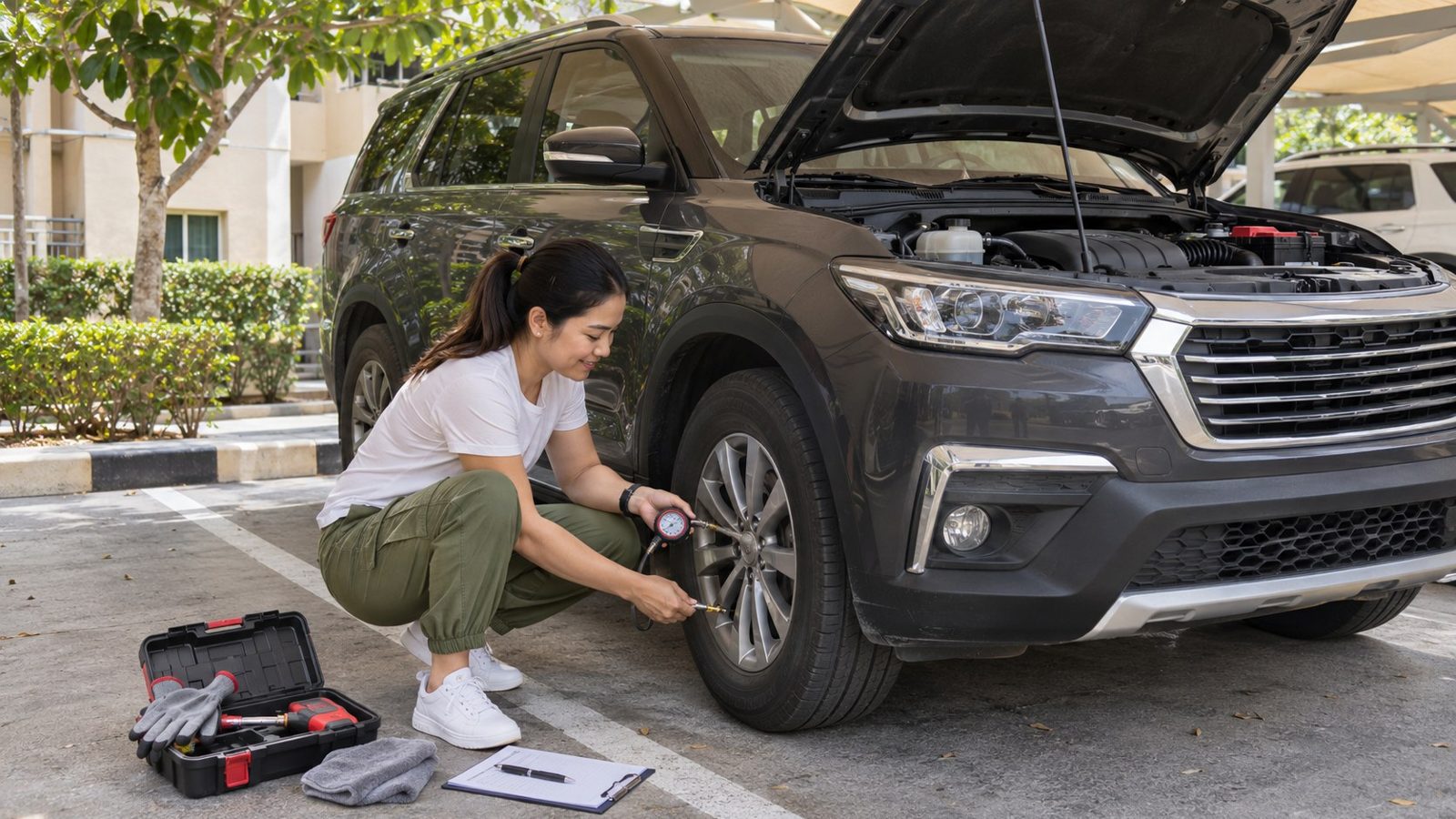
Check tyre pressures when the tyres are cold, using the manufacturer's recommended values shown on the vehicle placard or in the owner's manual.
Don't simply inflate them to the maximum pressure printed on the tyre sidewall.
Also inspect tyre condition and wear.
UAE summer temperatures make regular tyre checks particularly important for safety, not just fuel economy.
What about the air conditioning?
Let's be realistic.
Nobody wants to drive around Dubai in July with the AC switched off to save a little petrol.
And you don't need to.
Air conditioning adds an energy load, which can influence consumption.
But comfort, visibility and safe driving matter.
Use the system efficiently.
Park in shade where practical. Use a sunshade. Ventilate a very hot cabin briefly when safe, then let the AC cool it.
Use automatic climate control where available and set a comfortable temperature rather than constantly switching between extreme settings.
Don't sacrifice safety or comfort to chase a dashboard number.
Stop carrying your whole house in the boot
Open your boot.
What's inside?
An old box of clothes? Unused equipment? A stroller you haven't needed for months?
Extra weight requires extra energy to move.
Remove items you don't regularly use, while keeping necessary emergency equipment.
If you have an external roof box, remember that it can increase wind resistance, especially at highway speeds.
Small improvements add up over time.
Don't ignore maintenance
A dirty or unsuitable filter, incorrect engine oil specification, dragging brakes or an unresolved engine fault can affect vehicle performance and efficiency.
Follow the manufacturer's maintenance schedule.
If the check-engine warning appears, arrange a proper diagnosis instead of hoping the problem disappears.
Use the recommended engine oil grade and approved replacement parts.
For hybrids, follow the manufacturer's specific maintenance guidance.
Measure your real fuel economy
Before assuming the car is inefficient, try a simple experiment.
At your next full refuel, reset your trip meter.
Drive normally.
At the following full refuel, record how many litres you added and how far you travelled.
Use the formula:
Fuel consumption (L/100 km) = Litres used ÷ Kilometres driven × 100
For example, suppose you drive 500 km and refill with 40 litres.
Your consumption is 8 L/100 km.
That's equivalent to 12.5 km per litre.
Repeat this over several tanks.
It gives you a much more useful picture than judging one unusually bad day in traffic.
For plug-in hybrids, fuel-consumption comparisons also need to account for electricity charged from the grid.
Give yourself a two-week challenge
For the next two weeks:
Drive smoothly. Follow speed limits. Check tyre pressure. Remove unnecessary weight. Monitor your fuel consumption.
Don't change everything at once if you want to understand which habit made the difference.
At the end, compare your consumption with your previous results under similar driving conditions.
Maybe you'll notice a meaningful improvement.
Maybe your vehicle was already performing normally.
Either way, you'll have actual data instead of guesses.
The cheapest fuel-saving feature in your car might be the way you drive it.
Quick fuel-saving checklist
- Accelerate and brake smoothly.
- Follow speed limits.
- Maintain recommended tyre pressure.
- Avoid unnecessary idling when safely parked.
- Remove excess cargo.
- Follow the scheduled maintenance plan.
- Use climate control sensibly.
- Track fuel economy over several refills.
Editorial references
- FuelEconomy.gov — Driving More Efficiently
- US EPA — Why Fuel Economy Varies
- FuelEconomy.gov — Vehicle Maintenance and Fuel Economy
Last editorial review: 11 November 2026. Actual fuel savings vary by vehicle, fuel type, traffic and driving conditions.